
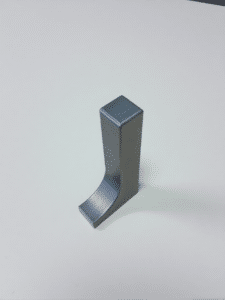
 Riveting remains one of the most reliable joining methods in the aerospace industry, particularly where welding is not an option. Behind a properly crimped rivet, however, lies an unassuming yet crucial tool: the rivet pile, also known as a counter-bouterolle.
Its purpose seems simple: to provide a reaction mass against which the rivet deforms. But its performance depends directly on a very specific shape and a density of the material from which it is made.
It is precisely the importance of tungsten alloys. With a density of approximately 18 g/cm³, they pack a considerable amount of mass into a small volume—a key advantage for precision riveting and hard-to-reach areas.
Refractory Metals Expert, Concept Métal assists manufacturers in selecting and manufacturing custom tungsten rivet stacks .
What is a rivet cluster, and what role does the hammer play?
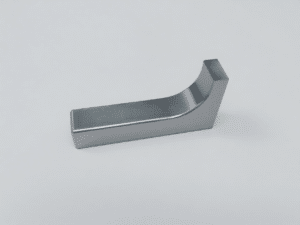 A rivet pile is a metal block that the operator holds firmly against one end of a rivet while the riveter or pneumatic hammer strikes the other end. The block does not strike; it provides resistance reaction mass which absorbs and reflects energy, allowing the rivet shank to deform properly to form the rivet joint.
The quality of the assembly therefore depends largely on this weight. A pile that is too light recedes with each strike, disperses energy, and produces uneven seams; the operator must compensate by exerting additional effort, which increases fatigue and the risk of error.
Conversely, a pile that is sufficiently and stable absorbs the energy without moving, ensures a consistent rivet, and reduces the number of strikes required.
The real challenge lies in achieving this high mass without taking up too much space. A steel block that is heavy enough quickly becomes bulky and therefore impossible to fit into a wing box or along a fuselage spar. Tungsten resolves this mass-to-volume trade-off better than any other common material.
Why is tungsten's density so important?
The density is the key factor that explains tungsten’s superiority for this application. Let’s compare the densities: steel has a density of about 7.8 g/cm³, lead 11.3 g/cm³, while heavy tungsten alloys reach 17 to 18.5 g/cm³. For the same mass, a pile of tungsten therefore occupies a volume less than half that of its steel equivalent.
High mass in a small volume
For the same reaction mass, the tungsten riveting pile is much smaller and easier to handle. The operator can access confined spaces where a steel pile of equivalent mass simply wouldn’t fit.
This feature is particularly sought after in the aerospace industry, where riveting is often performed in enclosed, confined spaces. The benefit is not merely practical: it determines the very feasibility of certain assembly operations.
Improved absorption of impact energy
Tungsten's high density also gives it excellent inertia. A dense pile remains stable under impact, effectively absorbs vibrations, and minimizes rebound. As a result, each strike from the rivet setter is more effectively transmitted to the rivet shank, the rivet head forms more quickly and consistently, and the stress transmitted to the operator’s wrist is reduced.
This combination of mass and damping explains why riveting professionals prefer tungsten whenever quality and working comfort become critical.
Which tungsten alloys are suitable for a riveting pile?
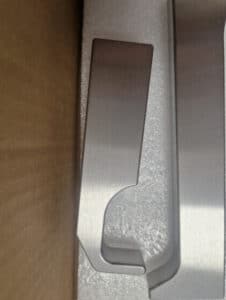 Pure tungsten is too brittle for a tool subjected to repeated impacts. Therefore, it is generally replaced by heavy tungsten alloys , specifically designed to achieve this balance between density, toughness, and machinability.
These alloys combine a binding matrix with a very high proportion of tungsten (typically 90 to 97%):
- W-Ni-Fe (tungsten-nickel-iron): the most common, durable, and easy to work with;
- W-Ni-Cu (tungsten-nickel-copper): nonmagnetic, useful when nonmagnetic properties are required.
With a density ranging from 17 to 18.5 g/cm³, they are ideal ballast materials. Unlike pure tungsten, they can be machined, drilled, and threaded, which allows for a variety of ball geometries and the addition of inserts or handles.
Another key advantage: tungsten is a non-toxic alternative to lead, which has long been used as a ballast material but is now phased out for health and regulatory reasons. You can find details about these grades on our page dedicated to heavy tungsten alloys.
How do you choose the geometry and mass of a rivet cluster?
Choosing a tungsten rivet pile is not limited to the material: the target mass and shape must be determined based on the job at hand. Several factors come into play.
The mass is selected based on the diameter of the rivets and the thickness of the sheet metal: the larger the rivet, the greater the reaction mass must be. The geometry depends on accessibility: flat, beveled, L-shaped, curved, or contoured to fit a specific area. Theergonomics, finally, determines the comfort and precision of the motion during long riveting runs.
Because these constraints vary from one construction site to another, the rivet pile is particularly well-suited to custom manufacturing. Concept Métal these tools based on your drawings, through our custom parts.
Which industries use tungsten riveting punches?
 The most iconic use remains theaeronautics : aircraft fuselage assembly and maintenance, where riveting in confined spaces requires equipment that is both heavy and compact. But other industries also use this technology.
These tools are used in aircraft maintenance (MRO), precision sheet metal work, railway construction construction, and the restoration of vintage aircraft—anywhere where rivet quality and access to tight spaces are paramount. In all these cases, the density of the tungsten offers the same benefit: concentrating maximum mass in a minimum of space.